Messenger wire for FTTH: how to choose the correct gauge for Peru
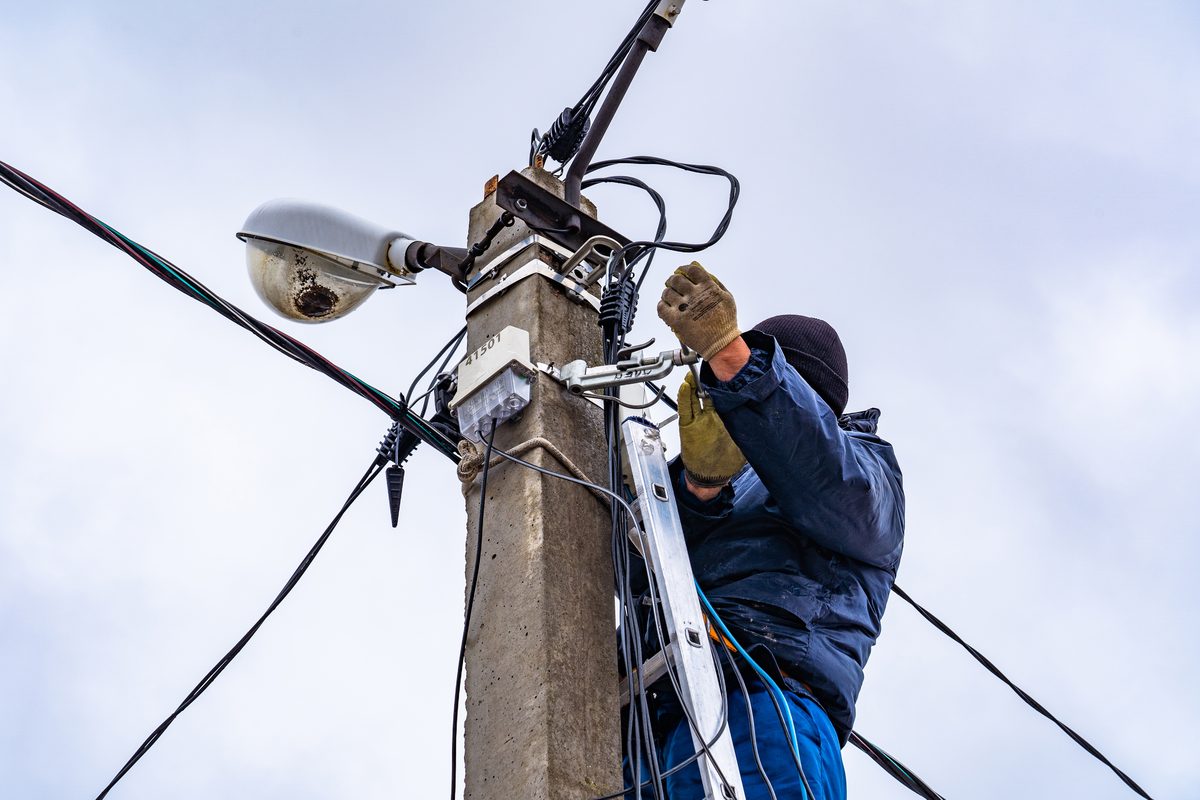
The messenger wire is the most overlooked component in aerial FTTH network design, and one of the leading causes of failure when incorrectly specified.
In Peru, it is common to find installations where the messenger wire was selected based on price or immediate availability, without considering the actual span, cable weight, or local climate conditions. The outcome is predictable: excessive sag causing the cable to contact branches or structures, messenger fatigue at anchor points, or total collapse during wind events.
This guide explains how to choose the correct gauge and why the decision matters more than it might seem.
What is a messenger wire and when is it used?
A messenger wire is a high-strength galvanized steel cable strung between two poles to serve as the load-bearing element for the fiber optic cable. The fiber optic cable is attached to the messenger using clamps or lashing wire, and remains suspended along the span without directly touching the pole.
It is used when the fiber optic cable does not have an integrated messenger (dielectric cable without steel reinforcement), or when the load-bearing capacity of an already installed section needs to be reinforced.
In distribution network projects (from node to CTO) and in backbone networks, the messenger wire is the structural element that determines how much the suspended cable can weigh and how far apart the poles can be spaced.
Key parameters for selection
1. Cable weight per linear meter
Each type of fiber optic cable has a weight per linear meter declared by the manufacturer (in g/m or kg/km). This is the starting point of the calculation.
Reference examples:
- ADSS cable 12F, 9 mm diameter: ~60-80 kg/km
- ADSS cable 24F, 11 mm: ~90-110 kg/km
- Central tube distribution cable 48F: ~120-160 kg/km
If you do not have the cable data sheet, request the nominal weight per km from the supplier before specifying the messenger wire.
2. Span length
The span is the horizontal distance between two consecutive attachment points (usually between poles, although it can be between a pole and a building facade).
Span length determines the messenger wire's sag: the curvature the cable assumes under its own weight. The longer the span, the greater the sag, and the higher the tension at the anchor points.
In urban FTTH networks in Peru, typical spans range from 30 to 60 meters. In rural or backbone zones, they can reach 80-100 meters.
3. Additional load from climatic factors
The messenger wire does not only bear the cable weight: it also supports additional loads from:
- Wind: In areas with strong winds (northern coast, Andean highlands, upper jungle), the lateral wind force can exceed the cable's own weight. It is calculated as the dynamic wind pressure on the projected cable area.
- Ice and hail: In the highlands above 3,000 meters above sea level, ice accumulation on the cable can multiply its effective weight by a factor of 2 to 4. This scenario is critical and often underestimated.
- Installation loads: The weight of a technician pulling the cable during installation generates point loads that can exceed several hundred kilograms.
Available gauges and their applications
Messenger wire is sold in standardized gauges (diameters). In Peru, the most commonly used for FTTH networks are:
| Gauge | Nominal diameter | Breaking strength (approx.) | Typical application |
|---|---|---|---|
| 3 mm | 3.0 mm | ~400-500 kg | Short spans <30 m, lightweight cables |
| 3.5 mm | 3.5 mm | ~550-650 kg | Spans 30-50 m, cables up to 100 kg/km |
| 4 mm | 4.0 mm | ~700-850 kg | Spans 40-60 m, cables up to 150 kg/km |
| 4.5 mm | 4.5 mm | ~900-1,100 kg | Spans 50-80 m, windy zones or highlands |
| 5 mm | 5.0 mm | ~1,200-1,400 kg | Spans >80 m, backbone, high-load zones |
Note: The breaking strengths listed are indicative. Always verify with the product data sheet. The design strength is calculated with a minimum safety factor of 3 over the total estimated load.
Practical selection rule by span and zone
For standard FTTH projects in Peru (distribution cable up to 150 kg/km), this reference table simplifies selection:
| Maximum span | Coastal zone (Lima, Callao, Piura) | Highlands (<3,000 masl) | Highlands (>3,000 masl) |
|---|---|---|---|
| Up to 30 m | 3 mm | 3 mm | 3.5 mm |
| 30 - 50 m | 3.5 mm | 3.5 mm | 4 mm |
| 50 - 70 m | 4 mm | 4 mm | 4.5 mm |
| 70 - 100 m | 4.5 mm | 4.5 mm | 5 mm |
| >100 m | 5 mm + specific calculation | 5 mm + specific calculation | Engineering required |
For spans exceeding 100 meters or zones with severe climatic conditions (winds >100 km/h, ice risk), a specific structural calculation is recommended.
The most common mistake: underestimating the actual span
In the field, spans rarely match the design drawings. The reasons are varied: variation in actual pole placement, route changes to avoid obstacles, building facades replacing poles in dense areas.
The most frequent mistake is using the design span instead of measuring the actual span in the field before placing the messenger wire order. A designed 50 m span that actually measures 65 m in the field can cause a 3.5 mm messenger to collapse under wind load.
Recommendation: Always measure actual spans before specifying the messenger wire gauge for the order.
Correct tensioning: sag as a reference
Once the messenger wire is installed, correct tensioning is verified by measuring the sag at the midpoint of the span. Sag is the vertical distance between the horizontal line connecting the two anchor points and the lowest point of the messenger wire.
The correct sag depends on the span and gauge, but as a general rule for urban FTTH networks:
- Recommended sag: between 2% and 3% of the span length
- Example: 50 m span → sag between 100 cm and 150 cm
A messenger wire that is too tight (sag less than 1%) concentrates all the load at the anchor points and increases the risk of fatigue failure.
A messenger wire that is too loose (sag greater than 4%) causes the cable to contact obstacles along its route and increases dynamic wind loading.
Material: standard galvanized vs. high-strength galvanized
Messenger wire is manufactured in two main variants:
Standard Galvanized (GS)
Low-carbon steel with zinc coating. Suitable for inland zones without salinity. Service life of 10-15 years under normal conditions. It is the most common standard and the lowest cost option.
Extra High Strength Galvanized (EHS)
Higher carbon content, breaking strength 30% to 50% greater than GS of the same diameter. Allows using a smaller gauge for the same load, or increasing structural safety without changing the gauge. Recommended for long spans, high-load zones, or critical backbone routes.
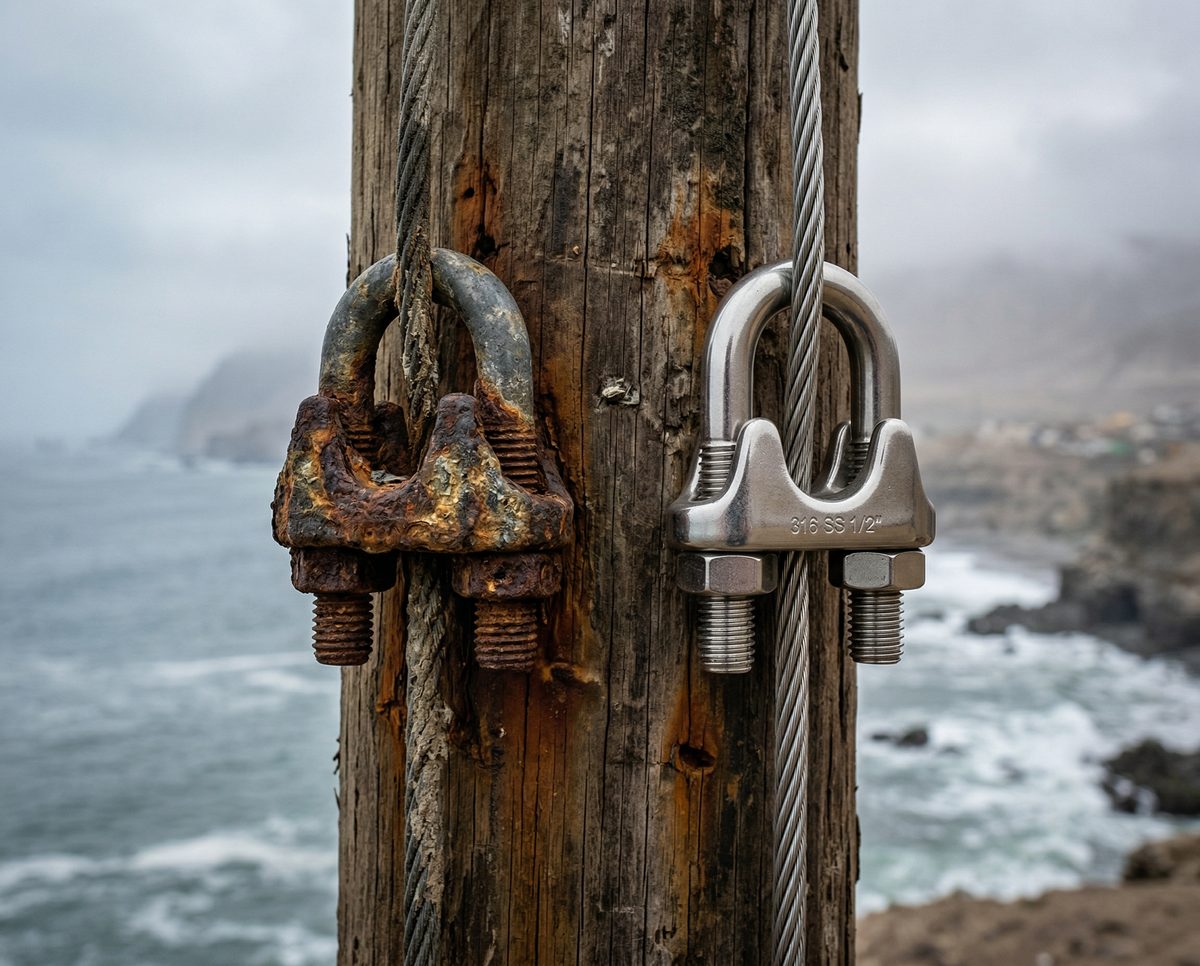
For coastal zones with salinity: Conventional galvanizing can degrade in 5-8 years. It is recommended to specify messenger wire with a thicker zinc coating (Class B or Class C per ASTM A-475) or evaluate alternatives based on the project budget. More on corrosion in FTTH hardware.
Messenger wire connector
The junction between two messenger wire sections (line splice) requires a stranded wire connector (also called a messenger connector or compression sleeve). This connector must have the same rated strength as the messenger wire to avoid creating a weak point in the line.
A splice made with lashing wire or a manual knot is not a structurally valid splice: it is a guaranteed failure point under load.
Stock available in Peru
Messenger wire for FTTH networks is available in stock in Peru in 3 mm, 3.5 mm, 4 mm, 4.5 mm, and 5 mm gauges, in spool presentation. Messenger connectors and associated anchoring hardware are also available.
For technical consultation on the correct gauge for your project:
+51 999 000 361 · +51 990 983 671
monstertek.net/contact
References
Need messenger wire for your project?
Tell us what you need and a specialist will contact you with availability, lead times, and pricing.
Talk to a specialist →